


You are paying for nine apps to do one job.
Each app injects its own scripts. Your product page now loads eleven third party requests and nobody can tell you which one is responsible for the layout shift.
Bespoke Liquid sections, metaobjects, custom product configurators and third party integrations. Written from scratch, documented and safe for whoever touches the code next.





Each app injects its own scripts. Your product page now loads eleven third party requests and nobody can tell you which one is responsible for the layout shift.
Your merchandising idea is sound. The theme just was not built for it. That is a development problem, not a strategy problem.
There is a section called custom-section-2-final-v3.liquid and nobody knows what depends on it. Every change is a gamble.
Modular sections with full theme editor schema so your team controls the content without touching code.
Structured content models for anything Shopify does not natively store: ingredient tables, size guides, care instructions, certification data, store locators.
Variant logic, conditional options, bundle pricing and line item properties that survive checkout.
Rebuild the two or three app dependencies costing you monthly fees and page speed as native theme code.
ERP, PIM, subscription platforms, review systems, loyalty and headless CMS connections through the Admin API or Storefront API.
Shopify Functions, checkout UI extensions, B2B catalogues and company accounts. [CONFIRM Plus scope]
| Shopify app | Theme customisation | Custom development | |
|---|---|---|---|
| Setup time | Minutes | Days | 1 to 3 weeks per feature |
| Ongoing cost | Monthly, forever | None | None |
| Page speed impact | Usually negative | Neutral | Controlled |
| Fits your exact need | Rarely | Partly | Exactly |
| Survives a theme update | Usually | Sometimes | Yes, if built properly |
| You own the code | No | Yes | Yes |
| Best for | Standard needs, testing an idea | Small tweaks | Features that differentiate you |
Day 0
Send us your store URL. We record a 10-minute video showing exactly where you're losing sales. Free, no strings. If it's not useful, delete it and move on.
Day 1–3
One call. We define what's being built, when it ships, and what it costs. You'll know the plan before any work begins.
Week 1–3
We design, you review, we build. Progress updates every working day. You watch the store take shape in real time on a staging link.
Week 3–4
We launch, test everything, and hand over clean documentation. Your team can manage the store without calling us for every tweak.
On Clutch

followers on Dribbble
36,500+
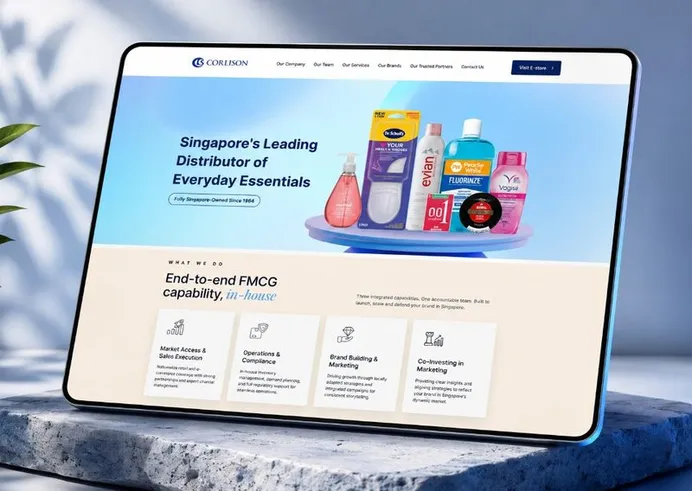
A polished Shopify connected web experience for Corlison, Singapore's FMCG distributor. Brand authority, capability storytelling, and a direct bridge into their e-store.
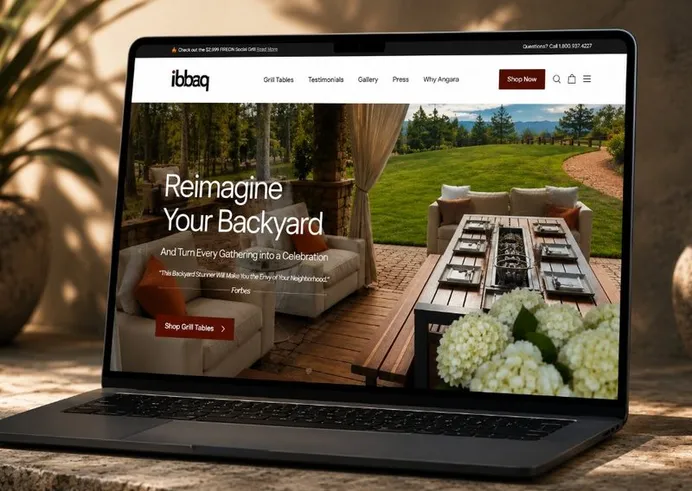
A luxury outdoor lifestyle Shopify store for ibbaq's social grill tables. Immersive photography, press backed trust, and shop first CTAs engineered for high ticket conversion.
36,500+ designers follow our work
Every proposal includes a delivery date. We've never missed one. If we ever do, you get 10% off. That's how confident we are.
No account managers playing telephone. You get a direct line to the designer and developer building your store, over Slack or email.
The number one reason brands fire agencies is silence. You'll get a progress update every working day. You will never chase us for status.
We don't do WordPress. We don't do Wix. Every hour we've ever billed has been on Shopify, and that depth shows up in your store.
Every project ships with a delivery date in writing. These are the brands that held us to it.
"Working with Devoq Tech felt seamless from day one. They rebuilt our store, cleaned up the checkout, and sales picked up within the first month. Clear communication and solid delivery throughout."
DR PRUSS · Clinical skincare
"From discovery to launch, the team stayed sharp and practical. The new store looks beautiful and customers actually stick around longer. Would happily work with them again."
sevenscents. · Ambient fragrance
"Our old site was holding the brand back. Devoq Tech redesigned the experience, tightened the messaging, and made the whole journey feel premium. Exactly what we needed for a growing catalog."
Corlison · FMCG distribution
"They understood a high ticket product needs trust before the add to cart. The store feels cinematic and shoppers finally get why the price makes sense. Launch was calm and on the date we agreed."
ibbaq · Outdoor lifestyle
Liquid is the open source templating language Shopify uses to render storefronts. Everything a shopper sees is Liquid pulling data from Shopify and turning it into HTML. Custom Liquid means the feature is native to your theme rather than bolted on by an app, which means it is faster, free to run and fully under your control. If the design system itself is outdated, pair this with a Shopify store redesign.
Often yes. It usually pays for itself. If you are spending $200 a month across three apps that each do one small thing, rebuilding that as native theme code removes the fee, removes three sets of injected scripts and removes three points of failure. We will tell you which apps are worth keeping. Brands moving platforms first should see Shopify migration.
Not if it is built correctly. We keep custom work in separate section and snippet files rather than editing core theme files where possible and we document every touchpoint. Any unavoidable core file edits are listed in your handover so a future theme update is a known task rather than a surprise.
We build custom functionality inside themes and through Shopify's APIs. Full public app development for the Shopify App Store is a different discipline and we will refer you rather than pretend otherwise.
Yes. We often ship the design system and complex sections while an in house team handles day to day. We write code to be handed over, with comments and documentation, because that is the whole point.
Per feature, fixed, after a short scoping call. You will know what a product configurator costs before we start building it, not after.
We build primarily on Liquid because it is faster to ship and cheaper to maintain for most brands. If you have a genuine headless case, we will scope it honestly, including the reasons you might not want it. [CONFIRM Hydrogen experience]
Every commercial page cites public research and Shopify documentation. First party figures are labelled as such. We do not invent conversion percentages.
~70%
Average ecommerce cart abandonment rate across Baymard Institute studies, with design and trust among the measurable drivers.
Source: Baymard Institute≤2.5s
Largest Contentful Paint threshold Google treats as "good" for Core Web Vitals.
Source: web.dev≤200ms
Interaction to Next Paint threshold for a "good" responsiveness score in Core Web Vitals.
Source: web.dev≤0.1
Cumulative Layout Shift threshold Google treats as "good" for visual stability.
Source: web.devSections
Shopify Online Store 2.0 themes are built from sections and blocks merchants can rearrange without redeploying code.
Source: Shopify.dev36,500+
designers follow Devoq Tech on Dribbble (first party, public follower count).
First party: Dribbble5.0
Clutch rating shown as visible proof copy only. Not marked up as AggregateRating. [CONFIRM exact profile URL].
First party: Clutch
Get a free 10-minute teardown video of your Shopify store. We'll show you the exact leaks, slow sections, broken flows, design that's hurting trust, and how to fix them. No pitch. No pressure. Just useful.
followers on Dribbble
36,500+On Clutch
Takes 30 seconds. Delivered within 24 hours. Zero obligation.


